63'-64' Revivals in the Southern Armies...
In 1864 a "precious revival" at Dalton, Ga., 107 conversions in Brown's Brigade. One Chaplin described a log camp chapel soldiers built. The chaplains thought it would be large enough, "but when the great revival began," soldiers so crowded it that chaplains doubled its size. Still it was not large enough.
Revivals in other brigades, including several of Alabama. The general of Lowry's Brigade of Alabama and Mississippi baptized a dozen of his own soldiers. Fifty or so were converted in General Deans' Alabama Brigade.
"The wonderful work of grace is spreading all over the army," in April 1864 that 1,000 soldiers had publicly sought salvation.
A soldier stationed near Montevallo wrote in 1864 of 100 conversions to Christ through a Bible class and an association for soldiers. Among the 35th Alabama Regiment, "almost all our boys are religious," an officer told a chaplain who helped lead services in 1863.
An 1863 letter to an editor told of the Rev. W.H. Carroll of Alabama preaching to Law's Alabama Brigade at camp near Fredricksburg, Va.,
"How many parents' heart will be gladdened when the glorious news of a revival in our camp reaches them!" the writer said.
A chaplain for the 10th Alabama Regiment, the Rev. J.J.D. Renfroe, wrote of a "splendid protracted meeting" in the brigade. A co-worker said that hundreds professed faith. As he put it, "The shock of battle has been sanctified to the saving of souls."
Methodist evangelist the Rev. John B. McFerrin, baptized at Cambridge Campground in Limestone County, said he never saw more displays of God's power than in 1863-64 meetings.
Church historian Gardiner Shattuck Jr. wrote in Christian History magazine that 100,000 or more Confederate soldiers converted. The impact of revivals "surely was tremendous," he said.
“It is stated in books and papers that Southern children read and study that all the blood shedding and destruction of property of that conflict was because the South rebelled without cause against the best government the world ever saw; that although Southern soldiers were heroes in the field, skillfully massed and led, they and their leaders were rebels and traitors who fought to overthrow the Union, and to preserve human slavery, and that their defeat was necessary for free government and the welfare of the human family.
As a Confederate soldier and as a citizen of Virginia, I deny the charge, and denounce it as a calumny. We were not rebels; we did not fight to perpetuate human slavery, but for our rights and privileges under a government established over us by our fathers and in defense of our homes.”
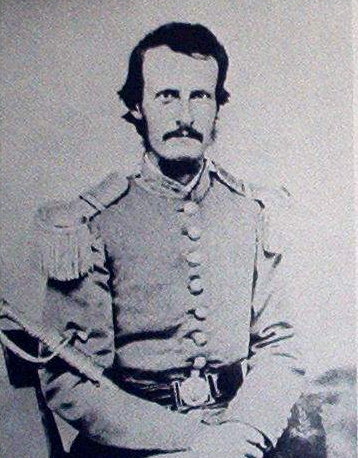
Colonel Richard Henry Lee, C.S.A.
Richard Lee - Resided at Charles Town when he enlisted in the Confederate Army on April 18, 1861 as a Lieutenant. Wounded at Kernstown, Virginia bearing the Fallen Flag to the front. Recommended to service on a military court. Later became Judge Advocate and Colonel of 2nd Corps Army of Northern Virginia.
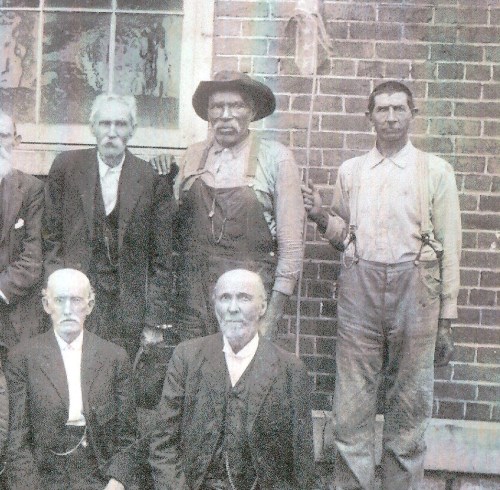
George Dance was in a picture that was made before 1914 at the Lynchburg, Moore County, Tennessee, courthouse. In it a number of elderly men were posing for a reunion for the area Confederate Veterans.
Other pictures from around 1900 taken from Gen’l N.B. Forrest’s Escort reunion, again reveal George Dance with his fellow Vets. For some people these pictures are a problem. For SCV members it is not! A check with a genealogical online service indicates George Dance was a Confederate Veteran.
He was obviously at a reunion with his veteran comrades. He had applied for a Confederate pension number C46 in Moore County, Tennessee, having served in the 8th TN Infantry, CSA. Oh yes, why is this a problem to some? George Dance is black. Was George a free black when the uncivil war broke out? Currently no information is available and more importantly, does it matter?
George Dance was born Jan 1, 1842 and died Nov. 12, 1924. This information was obtained from the photograph that also contained the dates of birth and death of the other men. Presently, very little is known about George Dance. The state of Tennessee census records of 1891, page 27, indicates he in District 1 as a registered male voter.
He, his wife America, and their three children are in the 1880 U.S. census of Moore County. He is listed as a farmer and she as keeping house. All are listed as being born in Tennessee. Next he was found in the 1910 U.S. census of Moore County as widowed, employed in a grist mill, and a survivor of the war. The census does indicate he said he was born in Alabama.
He is next found in the 1920 U.S. census of Moore County as widowed, not employed, and living with a son and family. A granddaughter is named America. Again it states he was born in Alabama.
In 1891 Tennessee established the Board of Pension Examiners to determine if Confederate veterans applying for pensions were eligible. Eligibility requirements included an inability to support oneself, honorable separation from the service, and residence in the state for one year prior to application.
Confederate veterans applied to the pension board of the state in which they resided at the time of application, even if this was not the state from which they served.
The application lists the veteran's place of enlistment, unit, period of service, battles participated in, and whether he was wounded or captured, as well as place of birth, number and gender of children, and value of personal and real property.
Singer Lionel Ritchie's ancestor was a recipient of one of these Tennessee Pensions.
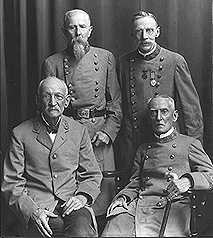
Photo: Pension Board Members Standing: Gen. John P. Hickman,
Col. Harry Rene Lee. Sitting: Gen. R. C. Crouch, Col. N. L. McKay
48th Tennessee at Camp Douglas Chicago 1862 (part I)
The 48th was one of the first units ever to be incarcerated in hastily prepared Union prison camps. The Federals sent the field grade officers to Fort Warren, Massachusetts, the line officers to Camp Chase Ohio, and the enlisted men to Camp Douglas in Chicago, Illinois. (The officers were later transferred to Johnson's Island on Lake Erie.)
The defeated Tennesseans began their trip north shortly after the surrender on the evening of 16 February. Grant's troops herded their prisoners aboard the steamer Empress. The steamer departed on the seventeenth and arrived at Cairo, Illinois, that night. The trip up the Mississippi was both uncomfortable and unhealthy. Many of the soldiers crowded aboard the Empress were already sick from exposure, poor diet, and frostbite.
Sanitary conditions on the vessel were poor. The weather was cold, and the rations consisted of crackers and raw meat. Along the route, Union soldiers gathered to taunt the prisoners. In response, Andrew Campbell reported, "Our men never failed to cheer for Jeff Davis and the Southern Confederacy." At two points along the river, unknown assailants fired shots at the vessel and several prisoners were wounded.
The Empress arrived at St. Louis on 20 February. The Confederates were surprised to find that the citizens of the city demonstrated pro-Southern sympathy by providing gifts of apples, cakes, tobacco, and money. The enlisted men boarded trains for Camp Douglas that evening, while the officers remained aboard other vessels for the next five days. Sympathizers risked insult and arrest to help the prisoners. One woman, who threw apples to the captives, was accosted by
a Union officer who shook his fist in her face.
To support her, one of the Confederate officers cut a button off his uniform and tossed it to the woman. When she attempted to retrieve the gift, a Federal guard stepped forward and "thrust his bayonet in front [of her] to push her back." Unimpressed, she simply pushed the bayonet out of the way and retrieved the button.
photo: Members of the 48th at Camp Douglas
Virginia was the only Southern State dismembered by the war. One third of her territory (the richest in many respects) and one third of her people were actually torn from her by the mailed hand of war not only without her consent but contrary to an express provision of the Federal Constitution. The true history of this “political rape” as it was termed by General Wise, is one of the blackest political crimes in the annals of history. “The Confederate Cause and Conduct in the WBTS”
West Virginia was allowed to secede from Virginia and was admitted into the Union as a “slave state” in June of 1863, 6 months after the Emancipation Proclamation took effect and in the second year of a war supposedly being fought to end slavery…
November 6 1865 CSS Shenandoah strikes her colors for the last time…
During 12½ months of 1864–1865 the ship undertook commerce raiding resulting in the capture and sinking or boarding of thirty-eight Union merchant vessels, mostly from New Bedford. This ship is notable for firing the last shot of the War, at a whaler in waters off the Aleutian Islands.
Captain Waddell and the crew knew returning to a US port would mean facing a Union court with a Northern perspective of the war. They correctly predicted the risk of being tried in a US court and hanged as pirates.
This later showed to be accurate. Commerce raiders were not included in the reconciliation and amnesty that Confederate soldiers were given. Captain Raphael Semmes ofCSS Alabama escaped charges of piracy by surrendering May 1, 1865 as a Ground General under Joseph E. Johnston. Semmes's former sailors surrendered as artillerymen.
The CSS Shenandoah was therefore surrendered by Captain Waddell to the Captain of HMS Donegal on November 6, 1865, after traveling 9,000 miles (14,500 km) to Liverpool to do so. This marked the last surrender of the War. She was then turned over to the United States government.