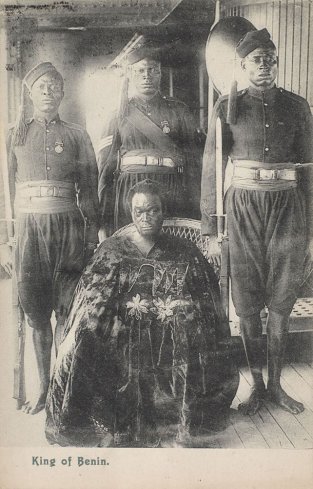
“We want three things: powder, ball and brandy; and we have three things to sell: men, women and children." African Chief
“but the inescapable fact that stuck in my craw was: my people had sold me…..My own people had exterminated whole nations and torn families apart for a profit before the strangers got their chance for a cut. It was a sobering thought." Zora Neale Hurston - considered one of the pre-eminent writers of twentieth-century African-American literature.
The British diplomat Wilmot, explained to King Gelele: "England has been doing her utmost to stop the slave trade in this country. Much money has been spent, and many lives sacrificed to obtain this desirable end, but hitherto without success. I have come to ask you to put an end to this traffic and to enter into some treaty with me."
Gelele refused: "If white men came to buy, why should I not sell?" Wilmot asked how much money he needed. "No money will induce me...I am not like the kings of Lagos and Benin. There are only two kings in Africa, Ashanti and Dahomey: I am King of all the Blacks. Nothing will compensate me for the loss of the slave trade." Gelele also told Burton, "If I cannot sell my captives taken in war, I must kill them, and surely the English would not like that. King Gelele of Africa
Glele, despite the formal end of the slave trade and its interdiction by the Europeans and New World powers, continued slavery as a domestic institution: his fields were primarily cared for by slaves, and slaves became a major source of 'messengers to the ancestors', in other words, sacrificial victims in ceremonies.
This image was taken by E.A. Baldwin June 5 1863. This is John Noland. Gus Myers spoke highly of this black man in notes in his journal. He is wearing a Confederate raider hat. He was Quantrill’s personal scout and spy. He later attended many of the Quantrill Reunions and was very highly respected.
All of his pall bearers were former Quantrill guerrillas, white men who loved him. Harry Truman may have known this man as he himself attended many Quantrill reunions.
The revival of 63' - 64' was not limited to enlisted men. It is well known that Generals Robert E. Lee and Thomas J. “Stonewall” Jackson were both pious, devout men, but during this time many Confederate officers were baptized, including A.P. Hill on the battlefield of Second Manassas, and Dorsey Pender.
By the end of the war, it is estimated that 100,000 Confederate soldiers in the Army of Northern Virginia alone surrendered to the Lord.
And the revival was by no means limited to the army in the East. There were signs of this revival in the Army of Tennessee even before Longstreet’s Corps joined it for the Chattanooga campaign, but the Spirit of revival surely came with Longstreet’s men. Estimates are that another 50,000 men from the Western armies were baptized. General Braxton Bragg had been baptized in mid-1863.
After the Battle of Missionary Ridge, the Army of Tennessee moved to Dalton Georgia for winter quarters. The soldiers built many churches while there. During that time, General Leonidas Polk baptized Generals J. E. Johnston, William J. Hardee, and John Bell Hood. Hood, unable to kneel due to his amputated leg, supported himself on a crutch and bowed his head.
So what was the effect of the great revival? Literally thousands of new churches were founded throughout the South after the war, creating the “Bible Belt”. By 1870, the number of churches and church membership had more than doubled from their number in 1860. I have read that there are more existing churches in the South that were founded from 1860 to 1870, than there are that were not founded during that period.
The newly found faith of the Southern people helped them through the horrible post-war period which included much of the population having died in the war, many thousands of men who were invalid or amputees due to wounds, not to mention the complete lawlessness of Radical Reconstruction.
For those of you that believe, my answer to his question was: surely God’s purpose for the Great Revival was to prepare the Southern people for what was to come to them for the next 17 years. Actually the next one hundred years.
At a dinner party during the war, a gentleman asked General Forrest, Why is it that your hair has turned gray and yet your beard has remained dark.” To which Forrest replied,
“Probably because I tend to work my brains more than my jaws.”
Unlike his Counterpart, Jefferson Davis didn't just use Christian rhetoric for political expediency...he really was a Christian.
Below is a Thanksgiving Proclamation by an American president, actually delivered on 4 September, 1862.
To the People of the Confederate States of America:
“Once more upon the plains of Manassas have our armies been blessed by the Lord of Hosts with a triumph over our enemies. It is my privilege to invite you once more to His footstool, not now in the garb of fasting and sorrow, but with joy and gladness, to render thanks for the great mercies received at His hand. A few months since, and our enemies poured forth their invading legions upon our soil. They laid waste our fields, polluted our altars and violated the sanctity of our homes. Around our capital they gathered their forces, and with boastful threats, claimed it as already their prize.
The brave troops which rallied to its defense have extinguished these vain hopes, and, under the guidance of the same almighty hand, have scattered our enemies and driven them back in dismay. Uniting these defeated forces and the various armies which had been ravaging our coasts with the army of invasion in Northern Virginia, our enemies have renewed their attempt to subjugate us at the very place where their first effort was defeated, and the vengeance of retributive justice has overtaken the entire host in a second and complete overthrow.
To this signal success accorded to our arms in the East has been graciously added another equally brilliant in the West. On the very day on which our forces were led to victory on the Plains of Manassas, in Virginia, the same Almighty arm assisted us to overcome our enemies at Richmond, in Kentucky. Thus, at one and the same time, have two great hostile armies been stricken down, and the wicked designs of their armies been set at naught.
In such circumstances, it is meet and right that, as a people, we should bow down in adoring thankfulness to that gracious God who has been our bulwark and defense, and to offer unto him the tribute of thanksgiving and praise. In his hand is the issue of all events, and to him should we, in an especial manner, ascribe the honor of this great deliverance.
Now, therefore, I, Jefferson Davis, President of the Confederate States, do issue this, my proclamation, setting apart Thursday, the 18th day of September inst., as a day of prayer and thanksgiving to Almighty God for the great mercies vouchsafed to our people, and more especially for the triumph of our arms at Richmond and Manassas; and I do hereby invite the people of the Confederate States to meet on that day at their respective places of public worship, and to unite in rendering thanks and praise to God for these great mercies, and to implore Him to conduct our country safely through the perils which surround us, to the final attainment of the blessings of peace and security.
Given under my hand and the seal of the Confederate States, at Richmond, this fourth day of September, A.D.1862.”
JEFFERSON DAVIS
Just a few things I'm sure Spielburg didn't mention in his movie...
Lincoln’s law partner states that, "Mr. Lincoln coveted honor and was eager for power. He was impatient of any interference that delayed or obstructed his progress.
He stood in direct conflict to the ideas of the founding fathers; they would not have supported Lincoln's economic policies of protectionism and the idea of a stronger central government. They would have choked at the idea of invading the southern states to "save" the union.
The war itself was fought over economic issues. Lincoln did not care about slavery and said repeatedly that it was not the cause of the war. This was confirmed by congress through the Crittenden Johnson resolution of July 1861. The war was actually caused by the invasion of 11 States that sought the same rights as their forefathers, to governed by something that had the consent of the people…
Lincoln said in his inaugural speech that there would be no invasions accept to collect taxes. American Heritage magazine in 1996 said that tariffs were a prime cause of the Civil War. Two weeks after Sumter Lincoln ordered a blockade of the South claiming tariff collection as his only motive.
There was no income tax in 1860, the government was funded by tariffs. The South being an agricultural society conservatively accounted for about 70% of the nation’s imports and therefore paid at least 70% of the nation’s taxes, yet the South only represented about 33% of the nation’s population. To add insult, most of the taxes collected in the South were spent in the North on roads, bridges, canals and railroads.
Lincoln was a sectional candidate, his New Republican Party was the only political party that was exclusively Northern in its affiliation and had virtually no Southern support. Elected by less than 40% of the popular vote, he did not even carry Philadelphia and New York two of the North’s largest cities. In the North he became an aloof dictator, shutting down over 200 newspapers that questioned his policies, he imprisoned Maryland legislators on suspicion of Southern sympathies, he deported his most vocal opponent in Congress, and violated the 2nd Amendment by disarming the border states.
He was the consummate politician who spoke out of both sides of his mouth, saying one thing to one audience and the opposite to another. His Emancipation Proclamation was the most hypocritical document ever written: it freed few if any slaves; it only applied to slaves in states that were in rebellion. Lincoln had no control over the states in rebellion, he couldn’t buy a newspaper in Charleston SC, let alone free slaves there. However, slaves in states where he did have control, those he did not free. For them it was as if no proclamation had ever been written. He himself admitted that the proclamation had No legal or Constitutional Justification.
He was adamantly opposed to racial equality, actually using the words "superior and inferior" to describe the "appropriate" relation between the white and black races. See his campaign speech in Charleston Illinois in 1858.
He opposed giving blacks the right to vote, to serve on juries, or to intermarry with whites. He supported the legal rights of slave owners and the Fugitive Slave Act. He pledged his support of a constitutional amendment (Corwin Amendment) that would have prohibited the federal government from ever interfering with Southern slavery. He was a railroad industry lobbyist who championed corporate welfare.
He once represented a slave owner in a case in which he sought to recover his runaway slaves. Lincoln lost the case and the slaves gained their freedom. He advocated sending all blacks back to Africa, Central America, or Haiti – anywhere but the U.S.
He opposed the extension of slavery into the territories so that "free white people" would not have to compete with blacks for jobs. He opposed black citizenship in Illinois and supported the state’s constitution, which prohibited the emigration of black people into the state.
He was the head of the Illinois Colonization Society, which advocated the use of state tax dollars to deport the small number of free blacks that resided within the state.
He sent troops to New York City to put down a draft riot by shooting hundreds of them in the streets. He was an enemy of free-market capitalism.
He started a war over tax collection that ended up killing 800,000 Americans and wounding and maiming hundreds of thousands more.
He promoted the lie that no such thing as state sovereignty ever existed to "justify" his invasion and conquest of the Southern states. He refused to meet with Confederate peace commissioners before the war to work out a peaceful compromise. The South was willing to pay it’s portion of the national debt and pay for all property confiscated by the South. He provoked Virginia, North Carolina, Arkansas and Tennessee to secede by launching a military invasion of their sister states. All four of these states had previously voted not to secede but now reversed themselves.
Although he used religious rhetoric in his speeches when it was politically expedient, Lincoln almost certainly was not a Christian. Lincoln struggled with severe depression.
Lincoln admirer Carl Marx sent him a congratulatory letter after his reelection in 1864; in which he stationed armed guards at polling places to intimidate voters.
On giving blacks the rights to full citizenship Lincoln stated on September 18 1858, “If the State of Illinois had that power, I should be against the exercise of it. That is all I have to say about it.”
Finally, by his own words Lincoln incriminates himself, in his first inauguration speech when he says; "We denounce the lawless invasion by armed force of the soil of any State or Territory, no matter under what pretext, as the gravest of crimes.”
We find the definition of treason in Article III section 3 of the Constitution where it states that “Treason against the United States shall consist only, in levying war against them...”
Lincoln was never president of more than half the country and no matter how you slice it, Union soldiers were not fighting to free slaves and Confederates were not fighting to keep them. There is nothing in the Constitution saying secession is illegal. Therefore, logic tells us there must be another reason.
Lincoln said his sole purpose for invading the South was to preserve the Union. Why force states to remain in the Union that did not want to be there? Why not just let the South go? Taxes that’s why. “Let the South go!” he said “where then shall we get our revenue?” (Bledsoe Treatise is J. Davis a traitor?)
Famed abolitionist Fredrick Douglas gave a scathing indictment of Lincoln’s racial policies in an April 14th 1876 speech, at which President Grant was in attendance. “He was preeminently the white man’s President, entirely devoted to the welfare of white men. He was ready and willing at any time during the first years of his administration to deny, postpone, and sacrifice the rights of humanity in the coloured people to promote the welfare of the white people of this country.”
Hardly seems the description of a Great Emancipator.
The early months of the War saw the assembly of armies that consisted of thousands of young men that had never before been away from home. Army chaplains complained that “seductive influences of sin” and “legions of devils” infested the camps. Among the sins were “spirituous liquors,” card playing, gambling, and profanity. Early in the war, one Confederate soldier said “if the South is overthrown, the epitaph should be ‘died of whiskey.’”
Though there were provisions made for chaplains in the Confederate Army, their pay was lower than that of other Confederate officers, and that of chaplains in the Union Army. There were a lot of issues in the attempts to form a legitimate chaplain’s corps in the Confederate Army. It is not known how many unpaid missionaries accompanied the army, and many pastors served as part-time missionaries. Conditions and provisions for chaplains improved when General Robert E. Lee took command in June 1862.
The beginning of the Great Revival appears to have started in the winter of 1862-1863 in Fredericksburg and the rest of the Lower Valley, and Chancellorsville, though its roots were earlier in the war. Some have narrowed it down to the first service performed at the Williams Street Methodist Church in Fredericksburg by the chaplain of the 17th Mississippi Infantry Regiment, of Barksdale’s Brigade, Rev. William B. Owen. He was soon joined by privates Clairborne McDonald and Thomas West of the 13th Mississippi, and they appeared to be filling the fairly large church seven nights a week. It was written in a letter by private William H. Hill of Company H, 13th Mississippi, that: “From 40 to 50 soldiers are at the mourner’s bench every night” waiting to be “saved” from their sins.
J. William Jones, Confederate chaplain and author of “Christ in the Camp”, notes that about the same time, similar occurrences were taking place in Trimble’s Brigade, in the 12th and 44th Georgia Regiments, after the army’s return from the Maryland Campaign.
To be continued...