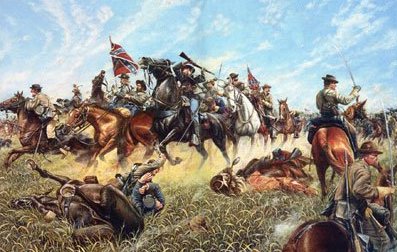
The great battle is very, very near, I think. I trust our prayers may be favorably considered by our God and that His hand will cover and protect me, so that when this unhappy war is over I may live to be a husband to you and a father to my children.
If it pleases God to take me away, thus early in life, bid my children, when they are old enough to understand, to be good and true men, doing their duty to you, to their country and to their God. Guard and guide them as if I were with you, and be to me a true wife, till God unites us in Heaven.
I trust and believe the coming fight will triumphantly vindicate the righteousness of our cause and though I may fall, yet I hope a blessed peace will soon give back to our country the comfort and prosperity so much to be desired. At my country’s feet I lay my young life. Into God’s keeping I leave yours. Micah Jenkins 5th South Carolina, A letter to his wife just before the Battle of Seven Pines May 1862
During the Battle of the Wilderness, Jenkins was riding with Lt. Gen. Longstreet when both were struck down by friendly fire on May 6, 1864. Jenkins died of his head wound a few hours later, and was buried in Magnolia Cemetery, Charleston, South Carolina, Longstreet survived the war.
Why we fought them and fought them hard...
General Philip Sheridan is another celebrated '' war hero '' who followed in Sherman's footsteps in attacking defenseless civilians. After the Confederate army had finally evacuated the Shenandoah Valley in the autumn of 1864 Sheridan's 35,000 infantry troops essentially burned the entire valley to the ground. As Sheridan described it in a letter to General Grant, in the first few days he '' destroyed over 2200 barns...over 70 mills... have driven in front of the army over 4000 head of stock, and have killed ... not less then 3000 sheep.... Tomorrow I will continue the destruction.''
In letters home Sheridan's troops described themselves as '' barn burners '' and '' destroyers of homes. '' One soldier wrote home that he had personally set 60 private homes on fire and opined that '' it was a hard looking sight to see the women and children turned out of doors at this season of the year.'' A Sergeant William T. Patterson wrote that '' the whole country around is wrapped in flames, the heavens are aglow with the light thereof ... such mourning, such lamentations, such crying and pleading for mercy [by defenseless women]... I never saw or want to see again.''
On one side of the conflict was the South, led by the descendants of the cavaliers, who with all their faults, had inherited from a long line of ancestors a manly contempt for moral littleness, a high sense of honor , a lofty regard for plighted faith, a strong tendency to conservatism, a profound suspect for law and order and an unfaltering loyalty to constitutional government.
“Against the South was arrayed the power of the North, dominated by the spirit of Puritanism, which, with all of its virtues, has ever been characterized by the pharisaism which worship itself and is unable to perceive any goodness apart from itself, which has ever arrogantly held its ideas, its interests and its will higher than fundamental law and covenanted obligations, which has always lived and moved and had its being in rebellion against constituted authority.” Robert Catlett Cave Confederate soldier and post war preacher.
Captain Fayette Hewitt
Hewitt was from Elizabethtown, Kentucky. His great contribution to War history is that he preserved the records of his Orphan Brigade, allowing the comprehensive history of the Brigade to be written. Hewitt served as a staff officer for Generals Albert Pike, Benjamin Hardin Helm (who ironically was a brother-in-law to U.S. President Abraham Lincoln) and, after Helm was killed at Chickamauga, Joseph Lewis. Hewitt was one generation out of Bedford County, Virginia. as his father had moved to Kentucky before he was born.
"His courage was one of that superior kind which enables a man to be perfectly collected and cool and not to be thrown off his guard or unsteadied by the most imminent and trying danger.
Going into the battle of Entrenchment Creek (Atlanta), he saw a soldier throw away his blanket because it was so in the way while fighting. General Hewitt remonstrated and told the man he would need it if wounded. Then he tied the blanket behind his own horse.
This horse was shot under him, and General Hewitt unbuckled the blanket and carried it till another horse was procured. After the battle General Hewitt restored the blanket to its owner, who was in the field hospital, badly wounded. The man said he had seen the horse shot; and if it had been him he would never have thought of that blanket, but only of getting away."
"Besides this horse, he had two others shot under him, but was never injured himself, though balls repeatedly passed through his clothing and hat and once through his hair."
Obituary in Confederate Veteran.
"The cause in which we are engaged is the cause of the advocacy of rights to which we were born, those for which our fathers of the Revolution bled - the richest inheritance that ever fell to man, and which it is our sacred duty to transmit untarnished to our children. Upon us is devolved the high and holy responsibility of preserving the Constitutional liberty of a free government." ~ President Jefferson Davis, June 1, 1861 ~
The Hampton Roads Peace Conference aboard the River Queen January 29 1865. The North's second attempt to lure the South back into the Union at the expense of Slaves once again failed...
No “Official” version of the meeting was recorded by Lincoln’s secretary, but the Confederate delegation did record theirs for posterity and it was quite revealing indeed. Mr. Seward indicated that this was to be an informal conference with no writing or record to be made, all was to be verbal, and the Confederates agreed.
The story of the peace conference is related by vice-president of the Confederacy, Alexander H. Stephens, in volume two of his work entitled A Constitutional View of the War Between the States: Its Causes, Character, Conduct and Results, at pages 589 through 625. This is obviously a view that the mainstream historians would not condone as “official” since it did not come from Lincoln’s mouth (when in fact it did).
(The subject of slavery then came up and Mr. Stephens asked President Lincoln what would be the status of the slave population in the Confederate states, and especially what affect the Emancipation Proclamation would have if the Confederates rejoined the Union. President Lincoln responded that the Proclamation was only a war measure and as soon as the war ceased, it would have no operation for the future. It was his opinion that the Courts would decide that the slaves who were emancipated under the Proclamation would remain free but those who were not emancipated during the war would remain in slavery.
Mr. Seward pointed out that only about two hundred thousand (200,000) slaves had come under the operation of the Proclamation and this would be a small number out of the total. Mr. Seward then brought up the point that several days before the meeting, there had been a proposed 13th constitutional amendment to cause the immediate abolition of slavery throughout the United States, but if the war were to cease and the Confederates rejoined the Union, they would have enough votes to kill the amendment. He stated that there would be thirty-six (36) states and ten (10) could defeat the amendment.
Remember President Lincoln, in his Inaugural Address before the war, gave his support to the first 13th amendment pending at that time which would have made slavery permanent and irrevocable.
Orphan Brigade Veterans- the nickname of the First Kentucky Brigade. They Fought with shot guns and hunting rifles, some had no weapons at all.
At the Battle of Stones River, General Braxton Bragg— rode among the survivors, crying out repeatedly, “My poor Orphans! My poor Orphans.” noted brigade historian Ed Porter Thompson, who used the term in his 1868 history of the unit. The term came from how the Confederacy viewed the Kentucky (a union state) soldiers. The term became popular after the war among the veterans.
When the Orphan Brigade was mustered into service, weapons were in short supply. The troops were armed with old smoothbore muskets (some flintlock and others percussion) along with shotguns and hunting rifles. Some men had no arms at all.
Only a week before the Battle of Shiloh, every regiment except the 9th Kentucky was issued a supply of Enfield rifles imported from England (the 9th armed themselves with Enfields captured during the battle).
When the unit surrendered in 1865, some men were still carrying the same rifles they’d had since Shiloh. PHOTO:Orphan Brigade- Confederate veterans’ reunion at John Thomas Daughaday’s farm
Confederate veterans' reunion at John Thomas Daughaday's farm; near Palmore, Graves Co., KY; typed list of names included:
FRONT ROW, L to R: James Murphy, James McNeely, James Karr Holloway (Co. G, 1st Texas Regiment, Infantry, Hood's Brigade), Jerome Willingham, John A. Blackburn, Samuel Theopolis Grace (Co. C, 7th Kentucky Regiment, Mounted Infantry), James Adams, John Thomas Daughaday, "Doc" Lawrence or Polk Willingham. SECOND ROW, L to R: Andrew "Nat" Yates, Felix Jones, Franklin Mullins, William Bostic, Will Linder, John A. Wilson, John Hampton Short (Co. E, 3rd Kentucky Regiment, Mounted Infantry), Acie Gates, George Cameron.
BACK ROW, L to R: Richard Johnson Grace (Co. G, 4th Kentucky Regiment, Infantry, Orphan Brigade), Tom Majors, William H. Lawrence (Co. G, 12th Kentucky Regiment, Cavalry), Lycurgus Willingham, Charlie Powell, Pat Wadlington (Co. E, 3rd Kentucky Regiment, Mounted Infantry), Henry George (Co. A, 7th Kentucky Regiment, Mounted Infantry), 1900
Part of Guide to the Confederate Veterans Reunion Photographic Collection, 1895-1924